
Explainer · August 7, 2026 · 5 min · By Fitzgerald Hanlon
G Prime, Explained: The One Number That Decides How Your Lip Filler Behaves
Injectors talk about soft gels and structured gels, but the difference comes down to measurable rheology. Here is what G prime actually means, why it matters more in lips than almost anywhere else on the face, and how to use it when comparing products.
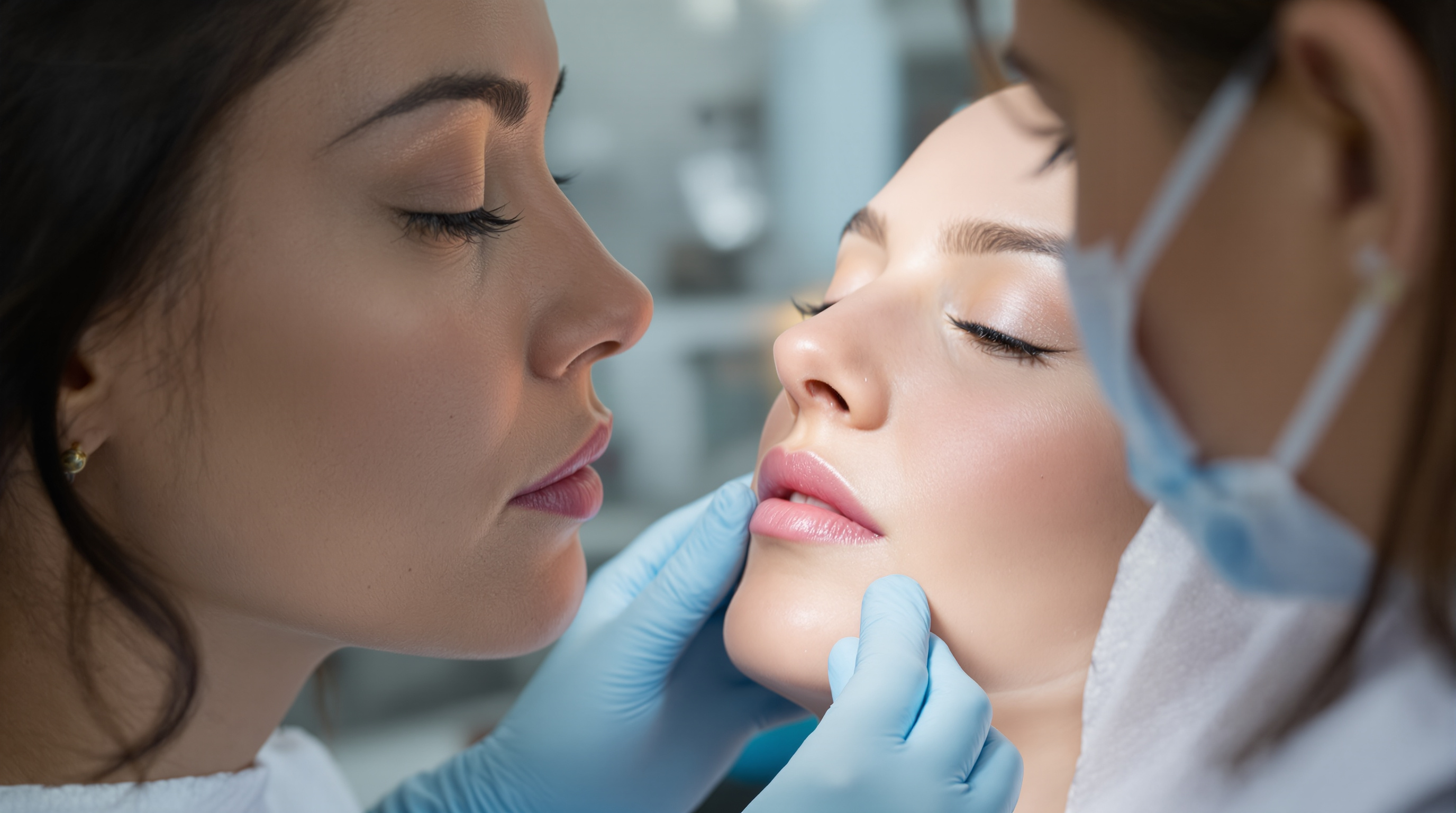
If you have shopped for lip filler, you have probably heard a version of this pitch: one product is "softer and more natural," another gives "more structure and projection." Those descriptions are not marketing invention. They are plain-English translations of a lab measurement called G prime, written G', which describes how much a gel resists deformation when force is applied. Understanding it will not make you an injector, but it will make you a far sharper consumer, because in the lips, rheology is destiny.
What G prime actually measures. Hyaluronic acid fillers are viscoelastic gels, meaning they behave partly like a liquid and partly like a solid. When a rheometer applies an oscillating stress to a sample, the elastic component, the part that pushes back and holds shape, is reported as G prime, measured in pascals. A high G prime gel resists compression and keeps its form under load. A low G prime gel yields, spreads, and integrates into surrounding tissue. Cheek and jawline products often sit in the hundreds of pascals. Fillers designed for lips typically run much lower, because the lip is a mobile, compressible structure that folds, stretches, and presses against itself thousands of times a day.
Why the lips punish the wrong gel. The lip has thin mucosa, a dense sensory nerve supply, and constant dynamic movement from the orbicularis oris muscle. Place a stiff, high G prime gel superficially in that environment and two predictable things happen. First, the product can feel palpable or lumpy, because the tissue is too thin to disguise a firm implant. Second, repeated muscular contraction can push a poorly matched or overfilled gel beyond the vermilion border, contributing to the shelf-like migration look. Migration is multifactorial, involving volume, depth, technique, and repeat treatment intervals, but product selection is one lever, and it is the one patients can actually ask about.
The trade-off nobody escapes. Softness comes at a cost. Low G prime gels tend to be less cohesive and more hydrophilic in some formulations, meaning they attract water and can swell more in the first one to two weeks. They also provide less vertical projection, so if your goal is a sharper Cupid's bow or visible border definition, an ultra-soft gel may look diffuse. Firmer lip-appropriate gels hold shape better but demand more precise placement and conservative volumes. There is no universally correct product, only a correct match between gel properties, anatomy, and goal. A patient with naturally full lips wanting hydration and smoothness needs a different rheology than a patient with thin lips wanting measurable projection.
Cross-linking is the mechanism underneath. Manufacturers control G prime mainly through cross-linking, the chemical bonds, usually created with an agent called BDDE, that tie hyaluronic acid chains into a network. More cross-linking generally means a firmer, longer-lasting gel, because the enzyme hyaluronidase, which your body produces naturally, takes longer to break down a densely bonded network. Manufacturing method matters too. Some technologies produce a smooth, cohesive gel that resists fragmenting; others produce calibrated particles suspended in a carrier. This is also why longevity claims vary so widely, roughly six to eighteen months depending on the product, the placement depth, your metabolism, and how much movement the area sees.
Questions worth asking at consultation. You do not need the exact pascal number, and most injectors will not quote one. Instead ask: Is this product specifically indicated or commonly used for lips? Is it a firmer or softer gel within that category, and why does that suit my anatomy? How much swelling should I expect given its water-binding behavior? What plane will it be placed in? Superficial placement of firm gels is where most palpability complaints originate. An injector who can answer those questions in plain terms is demonstrating exactly the kind of product literacy you want.
The bottom line. "Natural" and "structured" are not opposites of quality, they are points on a measurable spectrum. G prime is the physics behind why one syringe gives you soft, pillowy blending and another gives you crisp definition, and why the wrong choice in a highly mobile area like the lips shows up as lumps, migration, or disappointing projection. The best results come not from the most expensive gel or the newest launch, but from matching the mechanical personality of the product to the mechanical reality of your mouth. Ask about the match, not just the brand.
Related reading: Russian Lips and Other Filler Trends, Translated.